


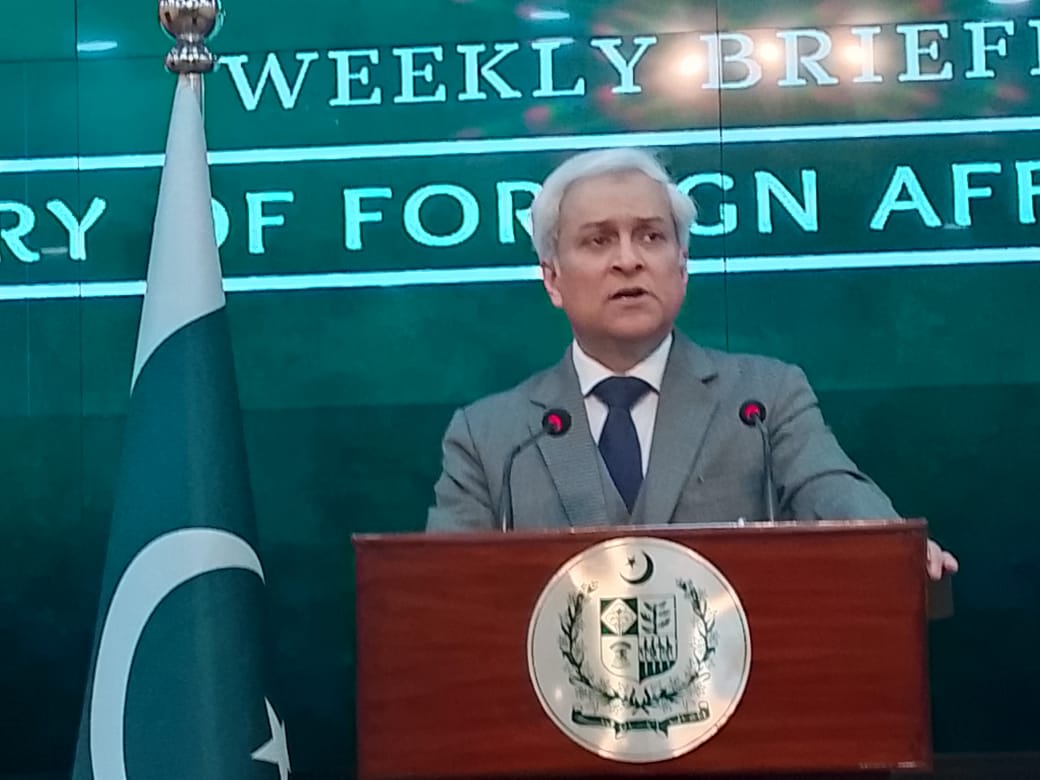
ISLAMABAD: Pakistan’s Ministry of Foreign Affairs on Thursday outlined extensive diplomatic engagements, high-level state visits, regional consultations, and key policy developments during the weekly press briefing delivered by the Foreign Office spokesperson.
The spokesperson said President of Uzbekistan Shavkat Mirziyoyev paid a state visit to Pakistan on February 5–6 at the invitation of Prime Minister Muhammad Shehbaz Sharif, marking his second visit and reflecting the growing strength of Pakistan-Uzbekistan relations. During the visit, the Uzbek leader met Pakistan’s president, held delegation-level talks with the prime minister, addressed the Pakistan-Uzbekistan Business Forum, and witnessed the signing of a joint declaration covering wide-ranging bilateral cooperation. Both sides reaffirmed their commitment to expanding trade to $2 billion by 2029, enhancing connectivity through the Uzbekistan-Afghanistan-Pakistan railway project, and deepening collaboration in multiple economic sectors.
Earlier, Kazakhstan’s President Kassym-Jomart Tokayev undertook his first state visit to Pakistan on February 3–4, accompanied by a high-level delegation. The visit resulted in a joint declaration on strategic partnership, agreements on security cooperation, counterterrorism, extradition, transit trade, agriculture, and UN peacekeeping collaboration, along with an ambitious target to raise bilateral trade to $1 billion. Both countries also emphasized regional connectivity initiatives and reiterated the need for a peaceful resolution of the Jammu and Kashmir dispute in line with UN Security Council resolutions.
Deputy Prime Minister and Foreign Minister Senator Mohammad Ishaq Dar held multiple high-level interactions during the period, including meetings and telephone conversations with leaders and foreign ministers of Azerbaijan, Cambodia, Iran, Uzbekistan, Türkiye, and the Commonwealth Secretariat, focusing on economic cooperation, regional stability, diplomacy, and multilateral coordination. Azerbaijan also conveyed condolences over victims of the recent Islamabad terrorist attack.
Pakistan additionally notified revised national export control lists under the Strategic Export Control Act, aligning them with international non-proliferation regimes and reaffirming the country’s commitment to responsible technology governance and global obligations.
The sixth round of Pakistan-Canada Bilateral Political Consultations was held in Islamabad, where both sides agreed to expand trade, strengthen institutional linkages, and maintain regular diplomatic engagement amid evolving global and regional dynamics.
During the week, Pakistan joined several Muslim and regional countries in two joint ministerial statements condemning Israeli actions in Gaza and the occupied West Bank, warning that ceasefire violations and settlement expansion threaten regional peace and undermine Palestinian statehood based on the June 4, 1967 borders with Jerusalem as capital.
Pakistan also hosted the informal retreat of D-8 Commissioners in Lahore, discussed preparations for the upcoming D-8 Summit in Jakarta, welcomed UNESCO Director-General Dr. Khaled El-Enany on his first bilateral visit since assuming office, and received Indonesia’s Minister for Investment and Downstream Industry Rosan Roeslani to advance economic cooperation.
The Foreign Office said the wide range of engagements reflects Pakistan’s proactive diplomacy, commitment to regional peace, and focus on economic connectivity and multilateral cooperation.
Pakistan Highlights Intense Diplomatic Engagement, Regional Cooperation and Export Control Reforms in Weekly Foreign Office Briefing. FO
54

