


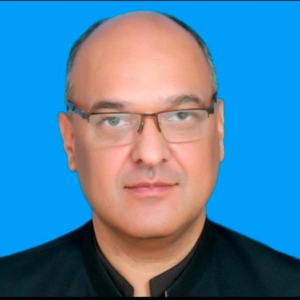
Abdul Basit Alvi
The current conflict between the United States and Iran, which erupted into open warfare on February 28, 2026, represents one of the most dangerous and consequential geopolitical crises of the twenty-first century, a conflagration that has drawn in not only the two principal antagonists but also Israel, the Gulf monarchies, and a host of regional actors in a widening spiral of missile strikes, drone attacks, and military escalation. The war began when the United States, in coordination with Israel, launched a massive joint military offensive against the Islamic Republic of Iran under the American code name “Operation Epic Fury,” targeting Iran’s nuclear infrastructure, Islamic Revolutionary Guard Corps command centers, and political leadership in a coordinated series of airstrikes that killed, among countless others, Iran’s Supreme Leader Ayatollah Ali Khamenei in the opening hours of the assault. This devastating initial blow was justified by the Trump administration as a necessary measure to destroy Iran’s missile capabilities, annihilate its naval forces, and ensure that the Islamic Republic could never obtain a nuclear weapon, with US Defense Secretary Pete Hegseth later revealing that more than 1,250 targets were struck within the first forty-eight hours of the campaign. The Israeli component of the offensive, dubbed “Operation Roaring Lion,” was framed by Prime Minister Benjamin Netanyahu as a vital effort to thwart existential threats to Israel and to neutralize what he characterized as great threats to America and the entire world. However, the scale and ferocity of the US-Israeli attack did not achieve the quick capitulation that its planners may have anticipated; instead, it unleashed a torrent of Iranian retaliation that spread across the Middle East with terrifying speed and intensity, as Iran launched wave after wave of missiles and drones targeting not only Israel but also American military assets spread throughout the region. Iran’s response to the initial assault was swift, devastating, and meticulously calculated to demonstrate the reach and lethality of its military capabilities. The Islamic Revolutionary Guard Corps claimed responsibility for what it described as sustained, multi-layered barrages lasting more than three hours, during which it fired a variety of advanced missiles including the “super-heavy Khoramshahr” variants, the Kheibar Shekan, and the Qadr missiles, many of which carried multiple warheads with some Qadr variants reportedly carrying one-ton warheads. These Iranian strikes targeted an array of critical locations, including the headquarters of the US Navy’s Fifth Fleet in Bahrain, US military bases in Iraq’s Erbil, Camp Arifjan in Kuwait, and other American facilities scattered across the Gulf region. Simultaneously, Iran launched sustained missile and drone attacks against Israeli territory, striking targets in Haifa, Tel Aviv, Jerusalem, and the Dimona area, which is home to Israel’s long-suspected nuclear weapons program, forcing civilians across Israel to take cover as air raid sirens sounded repeatedly and missile defense systems scrambled to intercept incoming projectiles. The Iranian offensive did not stop at American and Israeli targets; it also encompassed the Gulf states that host US military infrastructure, with Saudi Arabia’s Defense Ministry announcing that it had intercepted and destroyed multiple Iranian drones over its oil-rich Eastern Province and the Empty Quarter desert, where the critical Shaybah oilfield was targeted. The United Arab Emirates found itself under sustained aerial assault, with its Ministry of Defence reporting that its air defenses had successfully intercepted nine ballistic missiles, six cruise missiles, and 148 drones in a single day, and that since the beginning of the conflict it had detected 174 ballistic missiles and 689 Iranian drones, of which the vast majority were destroyed but a significant number landed within UAE territory, causing damage and disruption. Kuwait also came under attack, with a drone striking a fuel tank at Kuwait International Airport, creating a massive blaze that firefighters worked desperately to contain, while missile alert sirens sounded repeatedly across Bahrain as Iran maintained pressure on Gulf states hosting American forces. The conflict quickly demonstrated its capacity to disrupt global energy markets, as Iran effectively closed the Strait of Hormuz through which approximately twenty percent of the world’s oil and gas normally passes, sending crude oil prices spiking by as much as thirty-five percent, pushing Brent crude above one hundred and twenty dollars per barrel at the peak of the crisis and creating inflationary pressures that rippled through economies worldwide. The human toll of this expanding war has been staggering, with confirmed deaths exceeding 1,500 in Iran alone, more than 1,000 in Lebanon, dozens in Israel, at least thirteen American military personnel killed, and countless civilians across the Gulf states and West Bank also losing their lives in the crossfire. As the conflict entered its fourth week with no end in sight, the world looked for a mediator capable of bridging the chasm between Washington and Tehran, and it was at this critical juncture that Pakistan, under the extraordinary and synchronized leadership of Prime Minister Shehbaz Sharif and Field Marshal Asim Munir, emerged as the most active, credible, and effective diplomatic player in the crisis. Pakistan’s emergence as the lead mediator in the US-Iran war was not a spontaneous development but rather the culmination of a carefully orchestrated diplomatic campaign that leveraged the country’s unique geostrategic position, its long-standing relationships with both American and Iranian leadership, and the particular personal rapport that Field Marshal Munir had cultivated with President Donald Trump through meetings in June and September of the previous year. The decision to position Pakistan at the center of mediation efforts was driven by multiple urgent considerations, not least of which was the existential threat the war posed to Pakistan itself, a country already stretched thin by two active border conflicts—a volatile standoff with India to the east following India’s Operation Sindoor in May 2025, and a collapsed relationship with the Afghan Taliban that had led to Pakistan Air Force strikes on Taliban military positions in Kabul and Kandahar in February 2026—and now facing the prospect of a destabilized Iran on its western border, potentially unleashing floods of refugees and militants across the nine-hundred-kilometer border that separates the two nations. Moreover, Pakistan’s economy, already fragile and dependent on imports for more than eighty-five percent of its energy needs, was being crushed by the closure of the Strait of Hormuz, with fuel prices soaring, the government imposing a four-day work week, and liquefied natural gas stocks running dangerously low, creating a powerful economic imperative for the Sharif-Munir leadership to act decisively to end the conflict. The efforts of Prime Minister Shehbaz Sharif and Field Marshal Asim Munir to stop the war, secure a ceasefire, and facilitate a peaceful agreement have been nothing short of remarkable in their intensity, coordination, and effectiveness, drawing upon every tool of statecraft available to Pakistan’s civil-military leadership. At the highest levels of engagement, Field Marshal Munir held a direct telephonic conversation with President Donald Trump on Sunday, March 22, 2026, a conversation that was confirmed by multiple sources briefed on the call and that served to solidify Pakistan’s role as the principal intermediary between Washington and Tehran. This conversation was not an isolated event but part of a broader pattern of high-level engagement that saw senior Pakistani officials, including the country’s intelligence leadership, back-channeling communications between Tehran and key figures in the Trump administration, including US Special Envoy Steve Witkoff and the president’s son-in-law and envoy, Jared Kushner. Simultaneously, Prime Minister Shehbaz Sharif engaged in his own intensive diplomatic outreach, holding multiple telephone conversations with Iranian President Masoud Pezeshkian, during which he expressed solidarity with the Iranian people, conveyed condolences for the loss of life, stressed the urgent need for collective efforts to reduce tensions in the Middle East, and assured the Iranian leadership that Pakistan would continue to play a constructive role in facilitating peace. The parallel tracks of engagement—the Field Marshal communicating with Washington and the Prime Minister communicating with Tehran—created a comprehensive diplomatic architecture that allowed Pakistan to serve as an honest broker, carrying messages between the two adversaries and building the trust necessary to explore potential pathways to de-escalation. The sophistication of Pakistan’s mediation was further demonstrated by its coordination with other regional powers, as Foreign Minister Ishaq Dar held consultations with his counterparts in Turkiye and Egypt, creating a broader coalition of nations all working toward the same goal of ending the conflict, while Egypt reportedly contributed to the mediation by adding clauses related to Iran’s support for regional militias to the American proposal. The appreciation for Pakistan’s sincere and tireless efforts has come from the highest levels of leadership in both Washington and Tehran, representing a remarkable diplomatic achievement for the Sharif-Munir leadership. President Donald Trump, in a move that captured global attention and signaled Washington’s endorsement of Pakistan’s mediating role, publicly reposted Prime Minister Shehbaz Sharif’s tweet on his Truth Social platform—a tweet in which the Prime Minister had declared that “Pakistan welcomes and fully supports ongoing efforts to pursue dialogue to end the war in the Middle East, in the interest of peace and stability in the region and beyond,” and that “subject to concurrence by the US and Iran, Pakistan stands ready and honoured to be the host to facilitate meaningful and conclusive talks for a comprehensive settlement of the ongoing conflict”. Trump’s decision to share this post without comment was widely interpreted in diplomatic circles as a tacit but powerful endorsement of Pakistan’s mediation role, sparking fresh speculation about possible backchannel diplomacy involving Islamabad and suggesting that the idea of Islamabad as a neutral venue for high-stakes negotiations was gaining serious traction at the highest levels of the American government. The significance of this gesture cannot be overstated; for a sitting American president to publicly amplify the statement of the Pakistani Prime Minister on such a sensitive and volatile issue represented an unprecedented validation of Pakistan’s emergence as a credible diplomatic actor. Even more remarkably, Trump subsequently announced that he was ordering a five-day pause of all strikes on Iranian power plants and energy infrastructure, citing “very good and productive conversations with Tehran” over the previous two days—conversations that were widely understood to have been facilitated by Pakistan’s mediation efforts. The White House, while cautioning that the situation remained sensitive and fluid and that the United States would not negotiate through the press, confirmed that diplomatic discussions were underway, and CNN reported that the United States had conveyed a list of fifteen demands to Tehran through Pakistani intermediaries, a comprehensive proposal touching on sanctions relief, civilian nuclear cooperation, a rollback of Iran’s nuclear program, monitoring by the International Atomic Energy Agency, missile limits, and access for shipping through the Strait of Hormuz. On the Iranian side, appreciation for Pakistan’s sincerity has been equally significant, with Iranian leadership acknowledging the constructive role Islamabad has played in attempting to end the conflict. While Iran’s military command, through the Khatam Al-Anbiya Central Headquarters, publicly dismissed the ceasefire effort with defiant language—”Someone like us will never come to terms with someone like you. Not now, not ever”—the civilian leadership and foreign ministry engaged substantively with Pakistani intermediaries, acknowledging that messages were being received and appropriate responses were being given in accordance with Iran’s fundamental positions. Iran’s Foreign Ministry spokesman, Esmaeil Baqaei, confirmed that “over the past few days messages were received via certain friendly states conveying the US request for negotiations to end the war,” and while insisting that there had been no changes to Iran’s positions regarding the situation at the Strait of Hormuz or Tehran’s conditions for ending the war, he did not dismiss the mediation efforts outright. The Iranian leadership’s willingness to engage with Pakistan was grounded in decades of trust and cooperation between the two neighbors, as well as Pakistan’s unique position as the country that has hosted Iran’s diplomatic interests section inside its Washington embassy since 1992, making it Tehran’s only institutional back-channel to the United States. This structural advantage, combined with Field Marshal Munir’s ties to Tehran and the personal relationships he had built with Iranian military leadership over years of engagement, positioned Pakistan as the indispensable intermediary, capable of communicating with both sides in a language they understood and trusted. The appreciation was further underscored when Iran’s new Supreme Leader, Ayatollah Mojtaba Khamenei, who assumed leadership after his father’s death in the initial strikes, namechecked Pakistan in a written message published in Iranian media to mark the Iranian new year, stating that he had a special feeling towards the people of Pakistan, a gesture of warmth and recognition that signaled Tehran’s openness to Pakistani mediation. The international community at large has also expressed profound appreciation for Pakistan’s sincere efforts, recognizing that the Sharif-Munir leadership has stepped into a diplomatic vacuum and taken on the dangerous, delicate work of trying to pull two heavily armed adversaries back from the brink of a full-scale regional war. The United Nations, the European Union, China, Russia, Turkey, Saudi Arabia, Egypt, and other major powers have all acknowledged Pakistan’s constructive role, with the Financial Times, the Irish Times, the Times of India, and other major international publications running extensive coverage of Pakistan’s mediation efforts. The White House press secretary, while urging caution about speculation regarding specific meetings, described the diplomatic situation as “sensitive” and noted that Pakistan was among the countries involved in these delicate discussions, a measured but significant acknowledgment of Islamabad’s role. The appreciation has translated into tangible diplomatic momentum, with reports suggesting that Islamabad is being seriously considered as a venue for potential talks between senior Trump administration officials and Iranian representatives, a development that would represent an extraordinary elevation of Pakistan’s status as a diplomatic hub and a trusted mediator on the world stage. Today, Pakistan finds itself in an unprecedented global spotlight, not as a country beset by internal challenges or regional complexities, but as a strong, confident, and respected nation whose voice in international affairs carries genuine weight and importance. The transformation has been swift and dramatic: Pakistan, which before the crisis was often viewed through the narrow lens of its economic difficulties and security challenges, has now emerged as an indispensable player in one of the world’s most dangerous conflicts, a country whose leaders are on the phone with the American president and the Iranian president simultaneously, shuttling proposals and building the architecture for a potential peace agreement. This elevation of Pakistan’s global standing is directly attributable to the leadership of Prime Minister Shehbaz Sharif and Field Marshal Asim Munir, whose coordinated, complementary approach has demonstrated that Pakistan can speak with one voice on matters of international importance. The Prime Minister has provided the political vision and diplomatic persistence, engaging tirelessly with the Iranian leadership and articulating Pakistan’s principled position on the world stage, while the Field Marshal has provided the strategic depth and personal relationships with American leadership that give Pakistan’s mediation its credibility and its weight. Together, they have shown the world that Pakistan is not merely a spectator to great power conflicts but an active, capable, and responsible stakeholder in international peace and security, a country that can use its unique position—its relationships with both Washington and Tehran, its experience with conflict and mediation, its geostrategic location at the crossroads of South Asia and the Middle East—to make a genuine difference in resolving crises that threaten the entire world. The men behind this remarkable rise of Pakistan—Prime Minister Shehbaz Sharif and Field Marshal Asim Munir—have earned not only the appreciation of the international community but also the profound gratitude and pride of the people of Pakistan, who have watched their country’s leadership navigate one of the most dangerous international crises of recent times with skill, courage, and unwavering commitment to peace. In a nation often divided by political differences, there has been a remarkable convergence of public support for the way the Prime Minister and Field Marshal have represented Pakistan on the world stage, with citizens from Karachi to Lahore, from Peshawar to Quetta, expressing pride in seeing their leaders engage on equal terms with the President of the United States, being praised by the leadership of Iran, and being thanked by the international community for their sincere efforts to stop the war. The sense of national pride is palpable and well-founded: Pakistan has demonstrated that it possesses not only the willingness but also the capability to play a leadership role in global affairs, to use its diplomatic resources and strategic relationships to advance the cause of peace, and to stand as a voice of moderation and responsibility in a world increasingly fractured by great power competition and regional rivalries. The people of Pakistan recognize that the stature their country now enjoys is the result of deliberate, courageous, and sustained effort by their leaders, who placed the national interest above all else and worked tirelessly to secure for their nation a position of dignity, influence, and respect on the global stage. As the war between the United States and Iran continues, with global markets held hostage by the closure of the Strait of Hormuz, with the human toll climbing every day, and with the specter of further escalation always looming, the efforts of Prime Minister Shehbaz Sharif and Field Marshal Asim Munir remain more critical than ever. The world looks to Pakistan not as a peripheral player but as a central actor in the search for peace, a country whose unique relationships, strategic position, and wise leadership make it the indispensable mediator in one of the most dangerous conflicts of our time. The appreciation that has come from President Trump, from the Iranian leadership, and from the entire international community is a testament to the effectiveness of Pakistan’s approach and the sincerity of its commitment to ending the war. The Pakistani Prime Minister and Field Marshal have shown that even in the darkest moments of conflict, when the machinery of war seems unstoppable and the momentum toward escalation appears inexorable, determined and principled diplomacy can make a difference. They have shown that Pakistan, a nation of over two hundred and forty million people with a rich history and a strategic location at the heart of Asia, can be not just a country that suffers from the conflicts of others but a country that helps to resolve them, a voice of reason, a force for peace, and a leader in the community of nations. Today, Pakistan stands in the spotlight, a strong country whose voice is sought after and valued, whose leaders are trusted by both sides of a bitter conflict, and whose emergence as a key mediator in the Iran-US war represents a defining moment in the nation’s history—a moment that will be remembered as the time when Pakistan, under the extraordinary leadership of Prime Minister Shehbaz Sharif and Field Marshal Asim Munir, stepped forward to meet the greatest challenge of its generation and, in doing so, elevated its standing in the eyes of the world and the hearts of its people forever.

