ISLAMABAD
Deputy Prime Minister and Foreign Minister Senator Mohammad Ishaq Dar has reaffirmed Pakistan’s commitment to strengthening its longstanding partnership with the Association of Southeast Asian Nations (ASEAN), emphasising enhanced cooperation in trade, investment, education, technology, climate change, food security and regional peace.
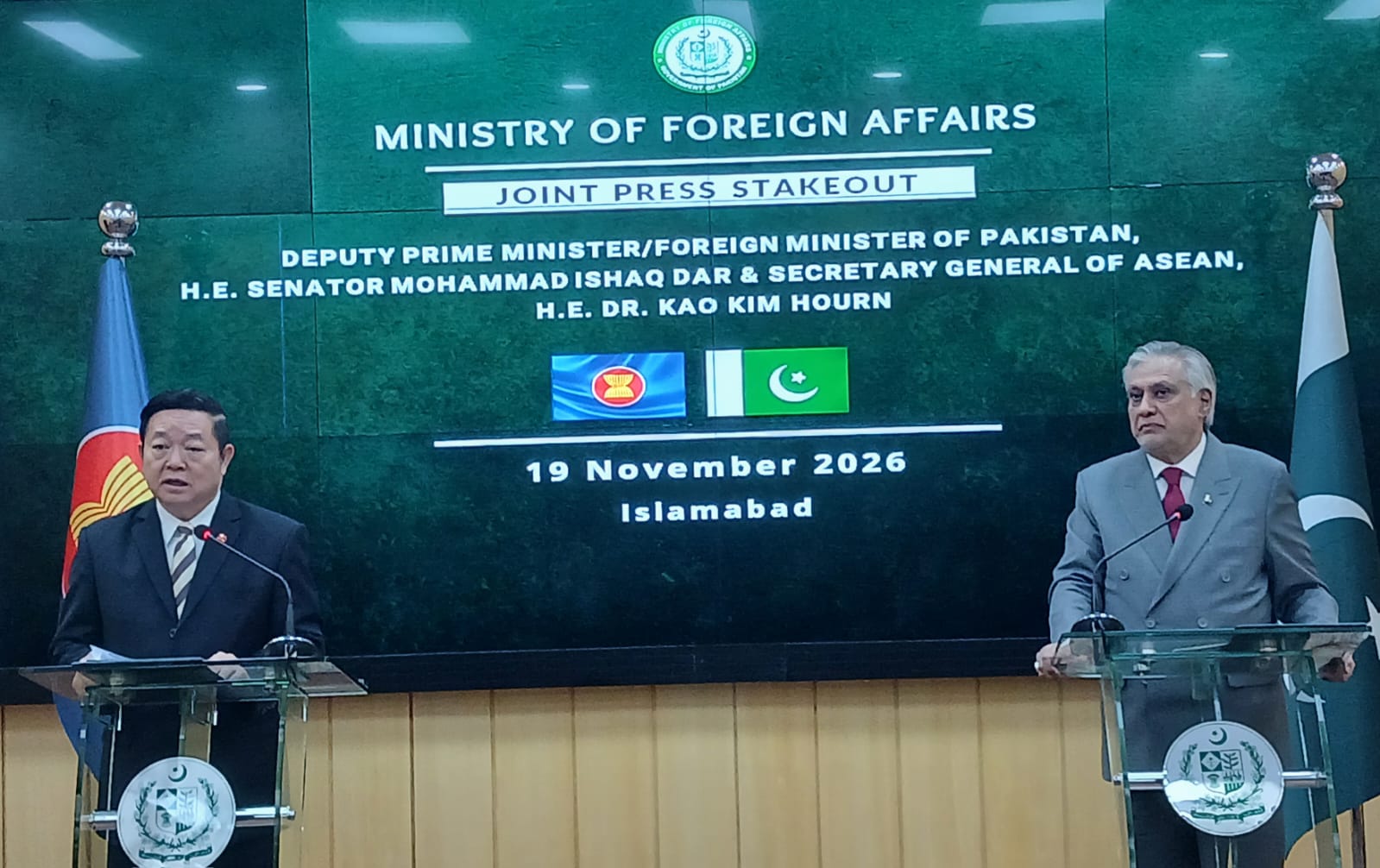
Speaking during a joint press stakeout with ASEAN Secretary-General Dr Kao Kim Hourn following their delegation-level talks at the Ministry of Foreign Affairs on Thursday, Dar said the visit offered an important opportunity to inject fresh momentum into Pakistan–ASEAN relations and translate shared aspirations into tangible benefits for the people of both sides.
Welcoming Dr Kao Kim Hourn to Islamabad, the Deputy Prime Minister described Pakistan and ASEAN as longstanding partners whose relations are rooted in mutual respect, goodwill and a shared commitment to peace and prosperity.
He recalled that Pakistan, as ASEAN’s oldest Sectoral Dialogue Partner, had remained committed to strengthening the partnership since 1993. He also noted that the Secretary-General’s visit marked the first visit by an ASEAN Secretary-General to Pakistan in more than two decades, making it an important milestone in bilateral engagement.
Dar said the discussions covered a broad range of political, economic and socio-cultural issues, with particular emphasis on expanding trade and investment, strengthening regional connectivity, promoting digital integration and enhancing cooperation in agriculture, food security and climate resilience.
Highlighting the importance of economic engagement, he said both sides had explored ways to facilitate trade, improve connectivity and establish stronger links between their respective markets. They also agreed to encourage exchanges of business delegations and strengthen institutional cooperation between chambers of commerce to create new investment opportunities, open markets and generate employment.
Referring to the ASEAN–Pakistan Business Conferences, Dar expressed hope that closer interaction between business communities would help develop sustainable commercial partnerships and strengthen economic ties.
The Deputy Prime Minister also underscored the importance of academic and technological cooperation, particularly in digital technologies and artificial intelligence. He said stronger institutional linkages between universities and research organisations could facilitate joint research, knowledge-sharing, skills development and exchanges of expertise, helping young people prepare for the rapidly evolving global economy.
Emphasising the significance of people-to-people contacts, Dar acknowledged the valuable contributions of Pakistani professionals working in ASEAN member states. He said both sides had agreed to promote cultural, academic and youth exchanges to deepen mutual understanding and foster enduring friendships.
On emerging security challenges, the Foreign Minister said Pakistan and ASEAN had agreed to strengthen cooperation in addressing non-traditional threats, including climate change, food insecurity, disruptions to energy supplies and cyber threats. He observed that collective responses to these challenges were essential for safeguarding public welfare and ensuring sustainable development.
Discussing regional and international developments, Dar stressed that secure maritime routes and uninterrupted supply chains were vital to economic stability and the livelihoods of millions of people. He reaffirmed the importance of dialogue and diplomacy, respect for international law and adherence to the principles of the United Nations Charter in addressing regional and global challenges.
He informed the ASEAN Secretary-General that Pakistan remained engaged with key regional and international partners to promote dialogue and diplomatic engagement, emphasising that diplomacy remained the only viable means of resolving outstanding issues.
On Palestine, Dar expressed serious concern over the continued expansion of illegal Israeli settlements and attempts to alter the status of the West Bank and Al-Quds Al-Sharif. He underscored the urgent need for unhindered humanitarian assistance to the people of Gaza and reiterated Pakistan’s unwavering support for an independent, sovereign, viable and contiguous State of Palestine, based on the pre-June 1967 borders, with Al-Quds Al-Sharif as its capital.
Regarding South Asia, he briefed the Secretary-General on the longstanding Jammu and Kashmir dispute, emphasising the need for a just, durable and peaceful settlement in accordance with the relevant United Nations Security Council resolutions.
Addressing the Indus Waters Treaty, the Deputy Prime Minister said India’s unilateral decision to hold the agreement in abeyance constituted a material breach of international law and represented a dangerous attempt to weaponise shared water resources. He warned that such actions threatened Pakistan’s water, food and energy security, affecting the lives and livelihoods of its 250 million people.
Dar also conveyed Pakistan’s deep concern over the continued use of Afghan territory for terrorist attacks against other countries, particularly Pakistan.
Concluding his remarks, the Foreign Minister thanked Dr Kao Kim Hourn and the ASEAN Secretariat delegation for their constructive engagement, saying the discussions had identified clear priorities for advancing cooperation.
He reaffirmed Pakistan’s commitment to working closely with ASEAN to strengthen institutional ties, promote sustainable business partnerships and expand opportunities for people across the region.
Dar expressed confidence that the momentum generated by the visit would help translate the shared ambitions of Pakistan and ASEAN into practical achievements, contributing to regional stability, economic growth and collective prosperity.