


203 
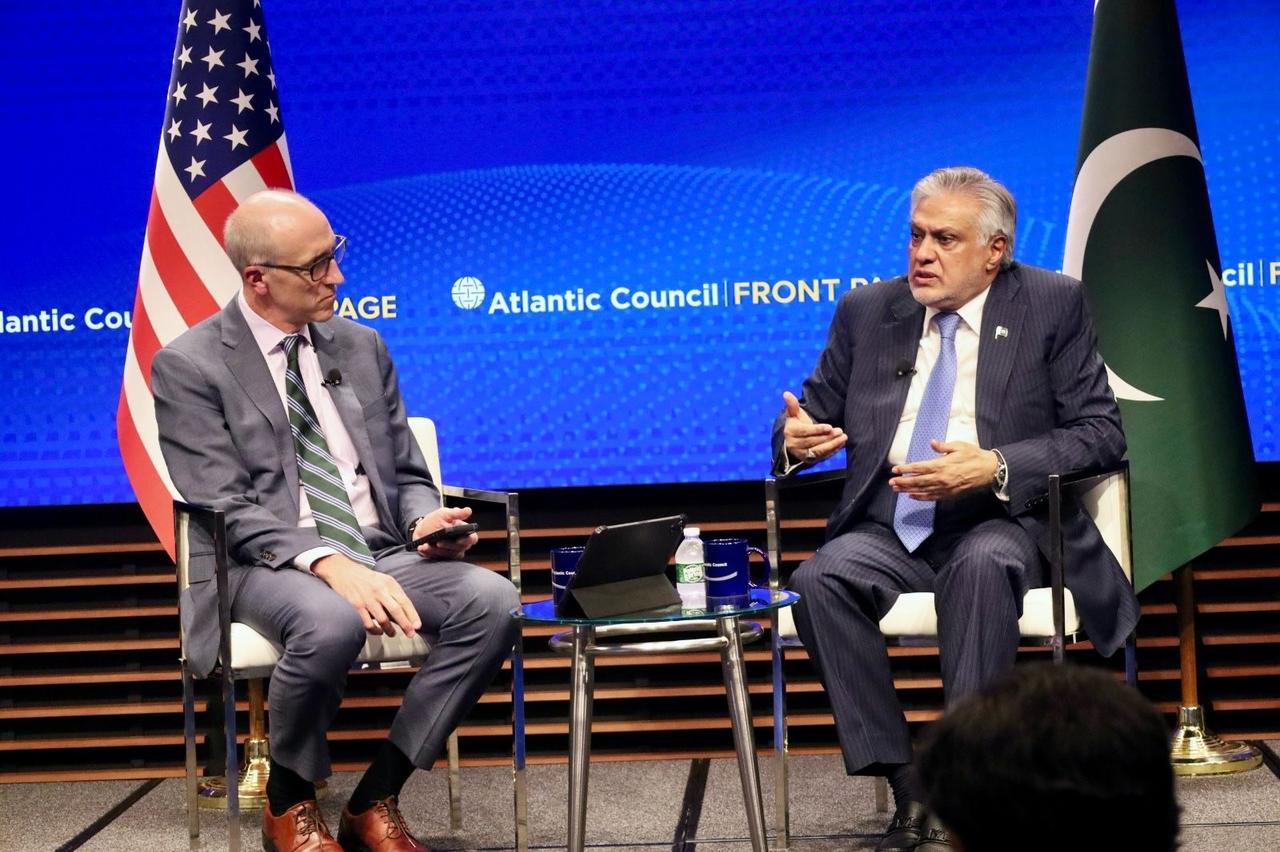
WASHINGTON: Pakistan’s Deputy Prime Minister and Foreign Minister, Senator Mohammad Ishaq Dar, delivered a keynote address at the Atlantic Council in Washington DC on Friday , outlining Islamabad’s foreign policy priorities, regional security concerns, and aspirations for deeper ties with the United States.
Speaking at one of the United States’ leading think tanks, Dar emphasized Pakistan’s commitment to “peace through resilience and responsibility” and described the country as a “peace-seeking and peace-loving nation” despite being a nuclear power.
“Stability in South Asia is vital – for us and for the world,” he said. “Borrowing from the ‘Peace through Strength’ paradigm, deterrence matters. So does dialogue.”
In a wide-ranging address, Dar noted that Pakistan was beginning to emerge from a period of economic hardship.
“Pakistan is turning a corner,” he said, citing the successful completion of the first review of the \$7 billion Extended Fund Facility program with the IMF as a key milestone.
He pointed to signs of macroeconomic recovery, including a stable exchange rate, declining inflation, an improved current account, and rising foreign exchange reserves.
“We took tough decisions to surmount external challenges to our economy,” Dar explained. “The government is committed to human development with substantial investments in health, education, skills development, and social protection.”
Dar reiterated Pakistan’s desire for a strong and mutually beneficial relationship with the United States, calling the bilateral partnership “enduring, wide-ranging, and evolving.”
“We seek a relationship grounded not in dependency, but in mutual benefit. Not in blame, but in dialogue,” he said. “Not in narrow counterterrorism checklists, but in broad-based cooperation.”
He described recent meetings with US officials as “very productive,” including one earlier in the day with Secretary of State Marco Rubio, during which both sides agreed to “deepen and broaden the Pak-US bilateral partnership.”
Highlighting economic ties, Dar said the United States remains Pakistan’s largest single-country export destination and that Pakistan is the second-largest buyer of US cotton.
“We see trade, not just aid, as the future,” he remarked. “We hope to conclude a mutually beneficial trade agreement at the earliest — hopefully in days, not in weeks.”
He also invited American investments in energy, mining, IT, and blockchain, and hinted at the potential of a future Free Trade Agreement.
On regional tensions, Dar sharply criticized India’s policies in Jammu and Kashmir, describing New Delhi’s 2019 move to revoke the region’s special status as “illegal and unilateral.”
“India’s actions to change the demographics of the disputed region are in contravention of international law, including the Fourth Geneva Convention,” he said. “The ‘New Normal’ India tried to establish has been buried between 7th and 10th of May.”
He said the recent ceasefire between India and Pakistan in May 2025 was made possible by US diplomatic engagement.
“We are thankful to President Trump, Secretary of State Rubio and his team for facilitating the ceasefire,” Dar said. “We never escalated as a first mover. We only acted in self-defense as per Article 51 of the UN Charter.”
However, he warned that South Asia cannot rely on “luck and last-minute interventions” to maintain peace and called for a “sustainable architecture for peace in South Asia.”
“We need the United States to play a constructive and stabilizing role in our region,” Dar emphasized.
Dar acknowledged that terrorism remains a serious challenge for Pakistan, especially from across the Afghan border. He noted progress in bilateral engagement with the Afghan Interim Government.
“The threat of terrorism from Afghan soil is real, and the biggest threat to Pakistan’s security,” he said.
He mentioned his visits to Kabul in April and July and said agreements were being implemented, including the signing of the Trans-Afghan Railway Project, which aims to link Uzbekistan, Afghanistan, and Pakistan.
“We continue to urge the Afghan Interim Government to fulfill their anti-terror commitments,” he said. “We have no ask — only that Afghan soil not be used against any country, especially Pakistan.
Dar expressed grave concern over the humanitarian crisis in Gaza and reiterated Pakistan’s longstanding position on the Israel-Palestine conflict.
“We call for an immediate ceasefire, durable peace, and the rebuilding of Gaza,” he said. “A two-state solution with pre-1967 borders and Al-Quds Al-Sharif as the capital is the only path to peace.”
He also advocated for de-escalation and diplomacy with Iran, referencing recent efforts by Pakistan to prevent the expansion of the Israel-Iran conflict.
“We supported regional diplomacy and tried to prevent the enlargement of what we saw in the 12-day war between Israel and Iran,” Dar said. “As a neighbor, we are performing this as a duty, not as an obligation.”
Dar acknowledged that US-China relations are the “most consequential” of the 21st century and offered Pakistan’s support in promoting dialogue between the two global powers.
“China is our strategic partner and the United States is our longstanding friend,” he said. “We have played the role of a bridge in the past and stand ready to do so again if called upon.”
He clarified that Pakistan’s foreign policy was not a “zero-sum game” and stressed the importance of avoiding bloc politics.
Concluding his address, Dar summed up Pakistan’s approach to international engagement:
“Pakistan seeks peace – with dignity. We seek partnerships – grounded in mutual trust and respect. And we seek progress – for our people, for our region, and for the entire world.”
The keynote underscored Pakistan’s evolving diplomatic posture: one that prioritizes regional connectivity, balanced international relations, economic reform, and a recalibrated partnership with Washington based on mutual respect and strategic convergence.

