


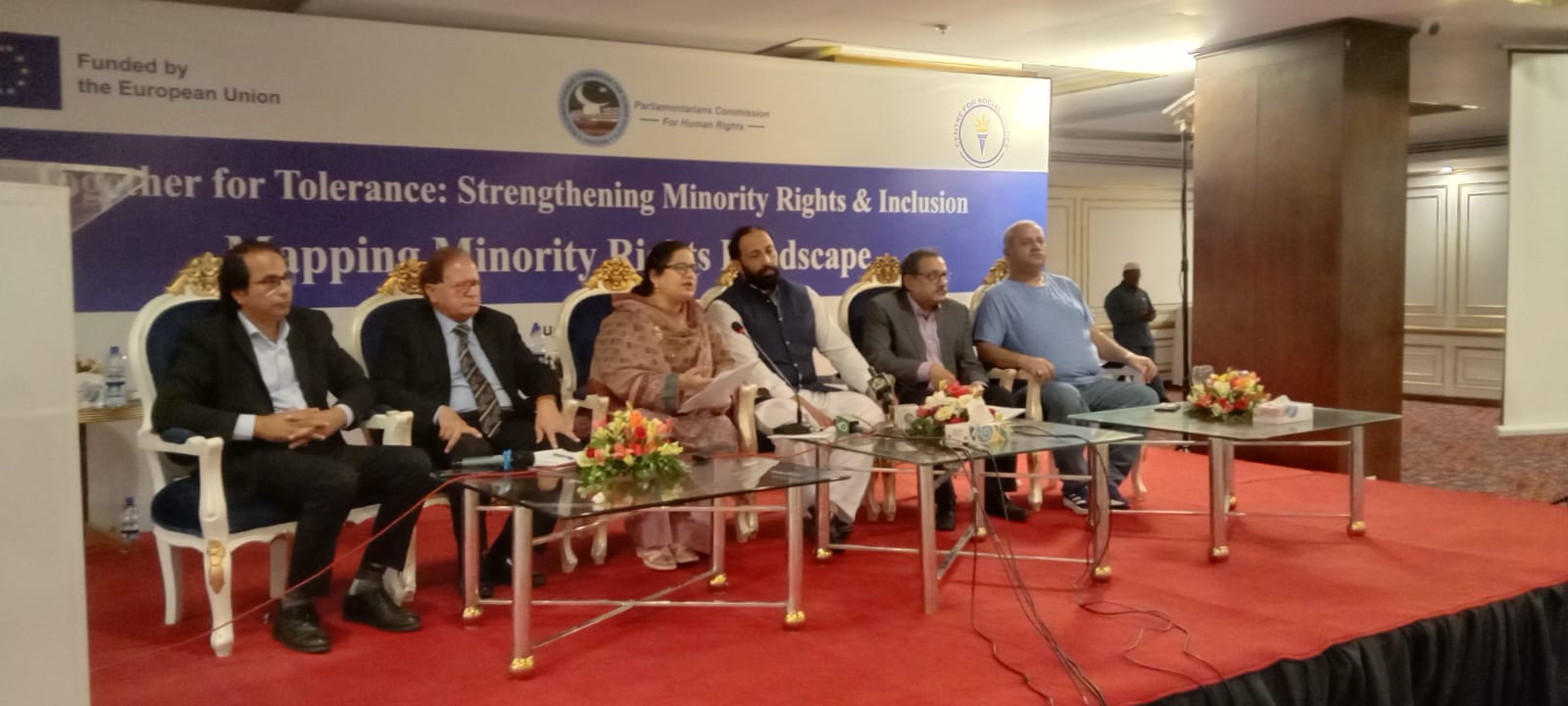
Islamabad: Despite constitutional guarantees and international commitments, the rights of religious minorities in Pakistan remain largely unfulfilled, a concern echoed by speakers at a high-profile seminar held in Islamabad to mark National Minority Day. The event, organized by the Parliamentarians Commission for Human Rights (PCHR), to discuss the preliminary findings of two parallel studies conducted to map the implementation of religious minority-specific policies, initiatives, and affirmative actions at both federal and provincial (Sindh & Punjab) levels
The studies were conducted under the European Union-funded project Together for Tolerance: Strengthening Minority Rights and Inclusion, implemented by PCHR with the Centre for Social Justice (CSJ) as a co-partner. The research offers a detailed analysis of the civil, political, economic, social, and cultural rights of religious minorities across the two provinces.
The leadership of the Parliamentarians Commission for Human Rights (PCHR), including Executive Director Mr. Shafique Chaudhry and Chairman Mr. Riaz Fatyana, emphasized the need for stronger legal and institutional measures to safeguard religious minorities, highlighting research findings on forced conversions, discrimination, and limited representation, and called for translating constitutional commitments into inclusive, practical reforms.
Mr. Abdul Khaliq Shaikh, Federal Secretary, Ministry of Human Rightsattended the inaugural session, while European Union Acting Head of Delegation, Mr. Philipp Oliver Gross, attended as the guest of honor of the ceremony.
In his address, Mr. Philipp emphasized that protecting freedom of religion or beliefincluding the rights of religious minoritiesis a priority for the European Union globally. They reiterated that the ratification andrespect of obligations under international human rights treaties are a requisite under the GSP+ scheme, which allows Pakistan to export to Europe without tariffs for a notable range of products. The EU is actively working with the government and civil society to advance the agenda of human rights and ensure that Pakistan respects its obligations.
Mr. Abdul Khaliq Shaikh, while sharing his thoughts highlighted that the Government of Pakistan is fully cognizant of the challenges faced by religious communities and is committed to introducing policies in line with the vision of the Founder of Pakistan, as articulated in his historic address to the first Constituent Assembly on August 11, 1947. He further emphasized that the Government of Pakistan values the support of the European Union and is making every effort to fulfill its obligations under ratified international treaties. Highlighting some key measures, he mentioned the proposed Bill to establish theNational Commission on the Rights of Religious Minorities, as well as various steps taken by the government in follow-up to the landmark 2014 Supreme Court judgment, commonly referred to as the TassaduqJillani judgment.He commended the efforts of PCHR in conducting the research studies and extended his full support, promising to incorporate the studies’ recommendations into the government’s reform agenda.
In his keynote address Dr. A.H. Nayyar highlighted the persistent gaps between constitutional promises and the lived realities of religious minorities in Pakistan. He stressed the need for proactive state measures to address systemic discrimination and ensure equal rights for all citizens.
Later, PCHR leading experts Dr. Shafqat Munir and Dr. Sofia Anwar presented the preliminary findings from two research studies, revealing a deeply concerning picture of minority rights in Pakistan. The data shows an alarming rise in forced conversions, especially targeting minor girls from Hindu and Christian communities in Sindh and South Punjab. Victims face severe legal hurdles, intense social pressure, and prolonged judicial delays. Attacks on religious sites including Ahmadi worship places, churches, temples, and minority graveyards — remain frequent, often met with only symbolic or no state response. Law enforcement agencies, particularly in rural Sindh and Punjab, are reported to act under pressure from extremist groups or to remain inactive in cases involving minority victims. Political representation is largely tokenistic, with minority leaders often co-opted rather than empowered, and systemic discrimination persists in access to public services and decision-making in both provinces.
On the socio-economic front, the situation is equally troubling. The 5% public sector job quota for minorities is rarely met, with over 70% of reserved posts unfilled. Minorities are disproportionately confined to sanitation roles regardless of qualifications, and some government job advertisements explicitly reserve low-grade positions for minority candidates, reinforcing occupational stereotypes. Minorities dominate the informal sector, where jobs are insecure and poorly paid, and face severe labour exploitation. In Punjab alone, there are 1.9 million child labourers, many from minority families, perpetuating intergenerational cycles of poverty.
Education remains a critical challenge: around 60% of minority students report facing discrimination, including denial of enrollment, segregation, and forced study of irrelevant religious content. In Sindh, 44% of minority children are out of school, compared to the national average of 27%. While a 2% educational quota exists, it is poorly utilized due to low awareness, bureaucratic hurdles, financial barriers, and systemic bias. Minority religion textbooks are largely absent, and school curricula often exclude minority histories and languages.
In housing and healthcare, minorities lack targeted health programs and often face stigmatization in public facilities. Many live in substandard housing without legal ownership rights, leaving them vulnerable to forced evictions. Despite the Sindh Protection of Communal Properties Act (2016), enforcement is weak, and attacks on minority-owned properties continue. Cultural suppression is also evident, with security threats and social pressure limiting the open celebration of religious festivals.
Key figures from both studies highlight:
- Over 70% of quota jobs for minorities unfilled
- 44% of minority children in Sindh out of school
- 60% of minority students report discrimination in schools
- 1.9 million child labourers in Punjab, many from minority backgrounds
Recommendations from the studies include enacting comprehensive anti-discrimination laws, criminalizing forced conversions, and aligning domestic laws with international human rights treaties; establishing an independent national commission on minority rights and appointing independent minority rights supervisors; ensuring targeted budget allocations for minority welfare; providing training for police and judiciary on minority rights; removing hate content from curricula, including minority histories and religions in textbooks, and creating child-protection cells in schools; ending bonded labour through vigilance committees, rehabilitation programs, and “Child Labour-Free Zones” in minority-concentrated areas; holding police and officials accountable for inaction in cases of violence or discrimination; and promoting interfaith dialogue, safeguarding heritage sites, and ensuring transparent recruitment for reserved posts.
The seminar concluded with an open session, where parliamentarians, including Mr. Nelson Azeem, Mr. Sanjay Parwani, Mr. Naveed Amir, and Senator Danesh Kumar, highlighted the challenges faced by religious minorities and underscored the steps needed on both legislative and societal fronts, noting that attitudinal changes are often more critical than legislation alone. Others who spoke on the occasion included Ms. Romana Bashir, Mr. Manzoor Masiah, Member NCHR, Ms. Sadia Bukhari and Mr. Basharat Masiah Advocate.

