


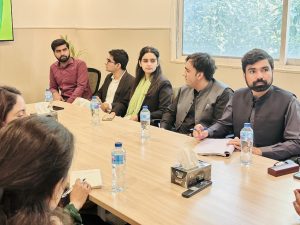
ISLAMABAD: Newly inducted officers of the Commerce and Trade Group, currently undergoing the 31st Specialized Training Program (STP) at the Pakistan Institute of Trade and Development (PITAD), visited the headquarters of the Pakistan Textile Council (PTC) in Islamabad as part of their training today.
The session introduced the officers to Pakistan’s textile and apparel sector, the country’s largest export industry and a key contributor to the national economy. They were briefed on the textile value chain, its role in the export basket and GDP, as well as the challenges the industry is facing and the policy measures required to enhance competitiveness.
In a detailed presentation, Muhammad H. Shafqaat, CEO of the Pakistan Textile Council, underlined the sector’s contribution to economic growth and exports. He pointed out major obstacles, including high costs of doing business and persistent policy uncertainty. He also discussed the potential impact of the European Union’s Green Deal on Pakistan’s trade, stressing the need for regionally competitive policies on energy, taxation, wages, and interest rates to keep pace with competitors such as Bangladesh, Vietnam, China, and India, especially in light of reciprocal tariffs from the United States.
The officers engaged in an interactive question-and-answer session following the presentation, focusing on issues of trade competitiveness, sustainability, and global market dynamics. At the conclusion of the visit, a commemorative shield was presented to the participants on behalf of the PTC.
Commenting on the initiative, the Minister of Commerce said such interactions are essential in preparing future policymakers to understand industry realities. He emphasized that exposure to the private sector helps civil servants address practical challenges, from energy and taxation to compliance with international trade requirements. “Once in service, these officers will hold positions where their decisions directly impact trade policy. This kind of engagement ensures they are better equipped to support industry competitiveness and design effective trade policies,” he said.
The current batch of civil servants will complete their specialized training in April 2025, after which they will take up postings in trade-related offices in Pakistan and abroad. —Internews
_________
11 killed, 28 injured in two separate traffic accidents in Balochistan
QUETTA, Sept 27 (Internews): Two separate traffic accidents in Balochistan claimed the lives of 11 people and left 28 others injured on Saturday, authorities reported.
In the first incident in Panjgur district, a coach traveling from Karachi collided with a truck carrying Iranian oil and diesel. The collision triggered a fire in the coach, resulting in the deaths of eight passengers and injuries to three others. Six of the deceased were residents of Khuzdar. Emergency teams rushed to the scene to rescue survivors and contain the fire.
The second accident occurred in Khanuzai tehsil of Pishin district, where a coach traveling from Quetta to Punjab collided with another vehicle. The crash killed three people and injured 25 others. Victims and the injured were transported to nearby hospitals, where the bodies were identified and handed over to their families, and the injured are receiving medical treatment.
Authorities have launched investigations into both accidents to determine the causes and are urging drivers to adhere to safety regulations, especially on busy highways, to prevent such tragedies. —Internews
__________
Peshawar High Court orders stay on deportation of Afghan husbands of Pakistani women
PESHAWAR, Sept 27 (Internews): The Peshawar High Court has directed authorities not to deport Afghan citizens who are married to Pakistani women, pending decisions on their citizenship applications. The court issued a written order clarifying the procedure for handling such cases.
The decision comes after a Pakistani woman filed a petition concerning her Afghan husband, who had applied for a Pakistan Origin Card (POC) through the National Database and Registration Authority (NADRA). The court instructed that NADRA must process the application according to the law, and until a final decision is made, the Afghan spouse should not be deported.
The court referred to a precedent set on December 1, 2023, in the case of Noreen Masood vs. the State. In that case, the court ruled that if one spouse is a Pakistani citizen, children’s registration cannot be denied. In the current case, the petitioner is a Pakistani national and has children with her Afghan husband.
The ruling emphasizes that the case should be resolved in accordance with the principles laid down in the December 2023 judgment. The petitioner was directed to formally apply to NADRA, which is required to examine the case legally, while ensuring the Afghan spouse remains in the country until a decision is made.
Legal experts say this ruling reinforces the rights of Pakistani women and their families, ensuring Afghan spouses are protected from deportation while citizenship and identity applications are pending. —Internews
173

