


ISLAMABAD:
The sit-in by the Tehreek-e-Tahaffuz-e-Ain Pakistan (TTAP) and Pakistan Tehreek-e-Insaf (PTI) entered its fifth day on Tuesday, with protests continuing at two locations within the Red Zone of the federal capital.
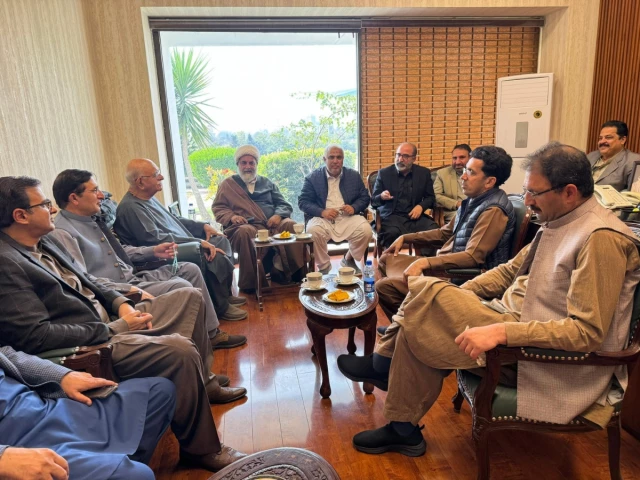
The sit-in, held within the premises of Parliament, is being led by Leader of the Opposition in the National Assembly Mahmood Khan Achakzai, with Leader of the Opposition in the Senate Raja Nasir Abbas also present. PTI Chairman Barrister Gohar Ali Khan, party leader Asad Qaiser and several senators are also in attendance at the parliamentary demonstration.A separate sit-in is simultaneously underway at the main gate of Khyber Pakhtunkhwa House, where Khyber Pakhtunkhwa (K-P) Chief Minister Sohail Afridi is present. Additional prison vans have been positioned outside the K-P House.Meanwhile, a meeting is underway in the Opposition Chamber under the chairmanship of Achakzai. Raja Nasir Abbas, Barrister Gohar and PTI Secretary General Salman Akram Raja are participating in the session, during which consultations are being held regarding the ongoing sit-in. The meeting is expected to determine the future course of action.
The ongoing sit-ins are linked to concerns over former premier and PTI founder Imran Khan’s health. The opposition lawmakers’ demonstration began on Friday and has continued despite government assurances.
Lawmakers, led by Achakzai and Abbas, have vowed their sit-in would not end until Imran is shifted for specialist care. Protesters have cited reports claiming his right-eye vision has deteriorated significantly and have demanded treatment in the presence of his family and personal physicians.
PTI rejects medical report
The federal government’s constituted medical board reported an improvement in Imran’s right-eye vision. The board, comprising two senior ophthalmologists, Dr Nadeem Qureshi and Dr Arif, examined him at Adiala Jail on Sunday.
According to the two-page report, unaided vision in Imran’s right eye was recorded at 6/24 (partial), while the left eye measured 6/9. With glasses, vision improved to 6/9 (partial) in the right eye and 6/6 in the left. The report stated that the anterior segment of both eyes was normal and the cornea was clear, while noting mild vitreous haemorrhage at the edge of the right eye and moderate retinal haemorrhage in all four quadrants.
The report added that swelling in the macula of the right eye was subsiding, with macular thickness reduced from 550 to 350 microns.
The board outlined ongoing medication and treatment and recommended OCT angiography and fundus fluorescein angiography after completing anti-VEGF therapy. However, it made no recommendation for Imran’s transfer to a hospital.

