



53 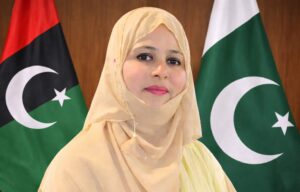
Raja Atif Raza
Karachi, Pakistan’s largest metropolis and economic engine, is a city of striking contrasts. It offers vibrant opportunities while also facing deep social and economic challenges. Millions of people pursue their ambitions here while navigating inequality, limited resources and rapid urban change. From this complex environment a new generation of leaders is emerging determined to reshape the political narrative. Among them is *Samreen Tabassum*, a rising political voice who sees politics not as a path to power but as a platform for service, representation and social progress.
As Vice President of the Women Wing in Karachi’s Korangi District, Samreen Tabassum represents a growing movement of women entering Pakistan’s political life with confidence and purpose. Her journey reflects a broader transformation across the country where women are increasingly stepping forward to take part in leadership and public decision making.
Born and raised in Karachi, Samreen Tabassum grew up witnessing both the promise and the difficulties of urban life. The city’s crowded streets, diverse communities and complex socio-economic realities shaped her understanding of society at an early age. She observed how poverty, limited educational opportunities and everyday struggles affected working families. These experiences helped develop in her a deep sense of social responsibility and commitment to public service.
Education played an important role in shaping her outlook. She completed her studies at Sir Syed College Nazimabad a respected academic institution in Karachi known for encouraging intellectual growth and civic awareness among students. During her college years Samreen developed a strong interest in leadership and community engagement. She came to believe that education is not only a means of personal advancement but also a powerful tool for social change.
Her political awareness was also influenced by her family’s connection with public life. Her grandfather was known as a senior figure within the *Pakistan Peoples Party (PPP)* and played an active role during important political periods of the party. Growing up in an environment where discussions about politics, community issues and public policy were common exposed her early to the realities of democratic struggle and civic responsibility.
However Samreen Tabassum’s political path has not been defined solely by family legacy. When she chose to enter active politics her aim was clear. She wanted to engage directly with communities, understand the concerns of ordinary citizens and contribute to meaningful solutions.
She formally joined the *Pakistan Peoples Party*, a party historically associated with democratic ideals, social justice and the empowerment of marginalized communities. Within the party structure she began working at the grassroots level building connections with local workers and encouraging women to take part in political activity. Many women who had previously remained outside the political process found encouragement through such efforts.
Her dedication and organizational ability eventually led to her appointment as *Vice President of the Women Wing in Korangi District Karachi*. Korangi is one of the city’s most populated and economically important districts. It includes large industrial areas as well as extensive residential communities. Because of its diversity the district faces a wide range of challenges including employment concerns, access to education, healthcare needs and urban infrastructure issues.
In her role Samreen Tabassum focuses on strengthening women’s participation in civic and political life. She believes that real social progress cannot be achieved unless women are actively involved in decision making processes. Through community engagement, advocacy and political organization she works to highlight issues such as education, healthcare and economic opportunities for women.
Her political philosophy centers on democratic values, inclusive development and social justice. She believes Pakistan’s progress depends on expanding opportunities for working families, ensuring fairness for marginalized communities and creating space for women to lead and contribute fully in public life.
At a time when political institutions around the world often face criticism and public skepticism leaders like Samreen Tabassum represent a new generation committed to rebuilding trust through service and engagement. Her presence in local politics reflects a wider shift in Pakistan’s political landscape where women are increasingly participating in shaping community initiatives and public discussions.
For Samreen Tabassum politics is ultimately about people. Public service remains at the heart of leadership. Guided by this belief she continues her work across Karachi especially in Korangi striving to empower women and amplify community voices.
Her journey is still unfolding but it already illustrates how determination, civic commitment and community engagement can open new pathways for women in politics. In a dynamic city like Karachi voices such as Samreen Tabassum’s are becoming an important part of the conversation about representation, opportunity and the future of democratic leadership.

