

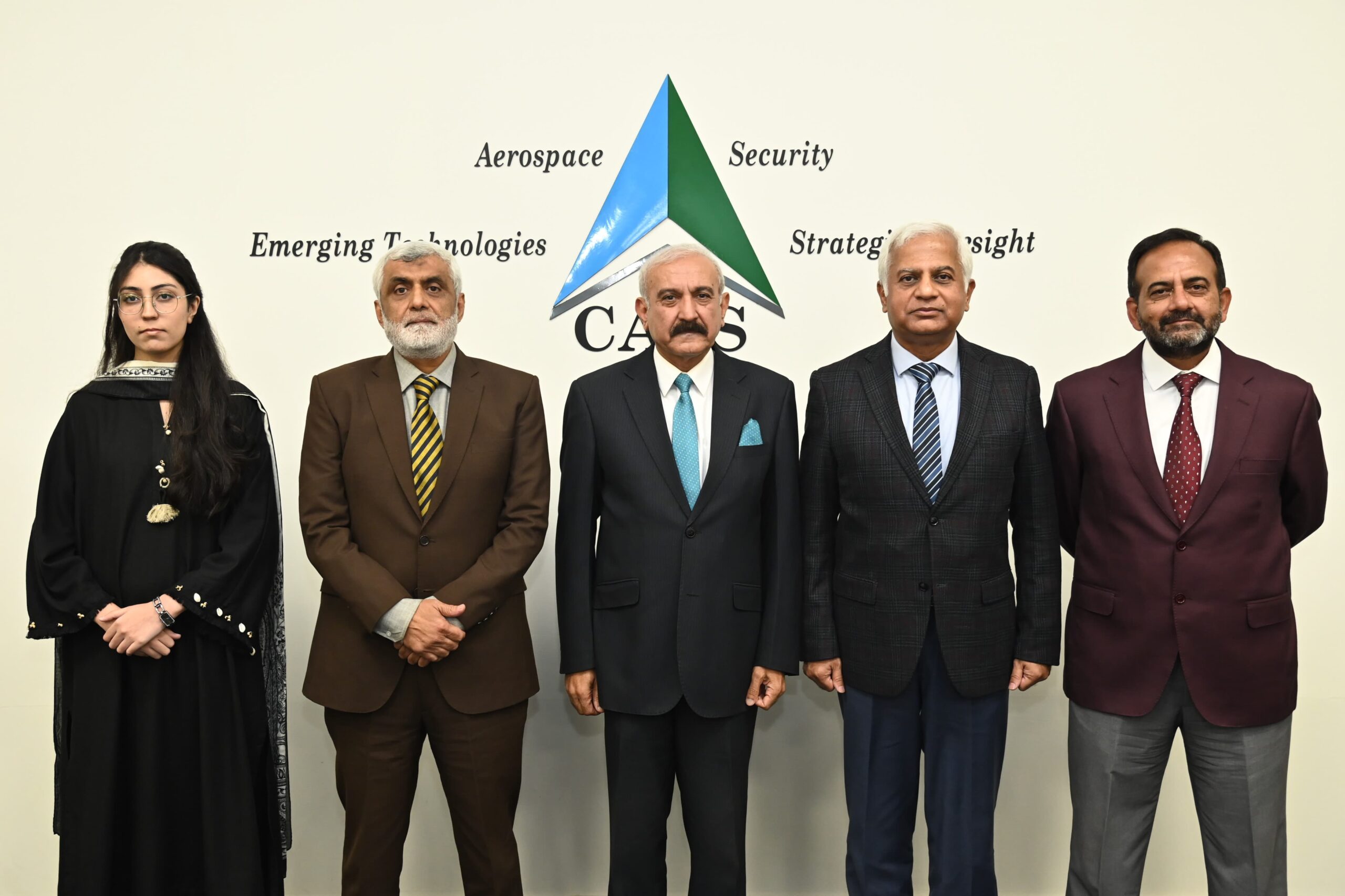
Islamabad: The Centre for Aerospace & Security Studies (CASS), Islamabad, convened a Roundtable Conference titled “Psychological & Strategic Layers of Air & Aerospace Power” on 23 October 2025. The event brought together distinguished practitioners, strategists, and scholars to examine how evolving doctrines, leadership paradigms, and cutting-edge technologies—such as Artificial Intelligence (AI), space systems, and Electronic Warfare (EW)—are reshaping the strategic balance in South Asia.
As an independent policy research institution, CASS continues to promote informed dialogue on emerging dimensions of national and regional security, fostering deeper understanding of the future of air and aerospace power.
Moderating the session, Air Vice Marshal Nasser ul Haq Wyne (Retd), Director CASS, underscored that modern air and aerospace operations require not only technological superiority but also clarity in doctrine and psychological preparedness. He noted that leadership, training, and rapid decision-making are now key determinants of success, particularly in an era where information cycles can influence perceptions as much as battlefield outcomes.
Delivering the keynote address, Air Marshal Zulfiqar Ahmed Qureshi (Retd), President of the Centre for Character & Leadership Development (JCCL) at PAF Academy, highlighted that contemporary aerospace power extends well beyond platforms and weapon systems. He emphasized that real strategic advantage lies in doctrine, employment strategy, leadership, and training—enhanced by integration of space, cyber, electronic warfare, and AI capabilities. These, he observed, compress the decision-making loop, enabling swift and effective responses. He added that nations prosper when they safeguard their citizens, and the Pakistan Air Force remains central to achieving this objective through its decisive and cost-effective application of aerospace power.
The second keynote speaker, Air Marshal Farooq Habib (Retd), former Director CASS, explored the psychological dimensions influencing public opinion and policymaking in modern conflict. He highlighted the need for resilience training for military leaders operating under uncertainty and deception, advocating scenario-based exercises and greater public awareness to counter adversarial psychological operations. He also urged leaders to ground strategy in social sciences, align political objectives with coercive power, and institutionalize information operations within air campaign planning.
In his concluding remarks, Air Marshal Javaid Ahmed (Retd), President CASS, expressed gratitude to the speakers for their insights, noting that as warfare extends into cyber, space, and information domains, the psychological aspect of deterrence is becoming as crucial as technological capability. He reaffirmed CASS’s dedication to advancing strategic thought that fuses intellect, innovation, and resolve in support of Pakistan’s national security.
