

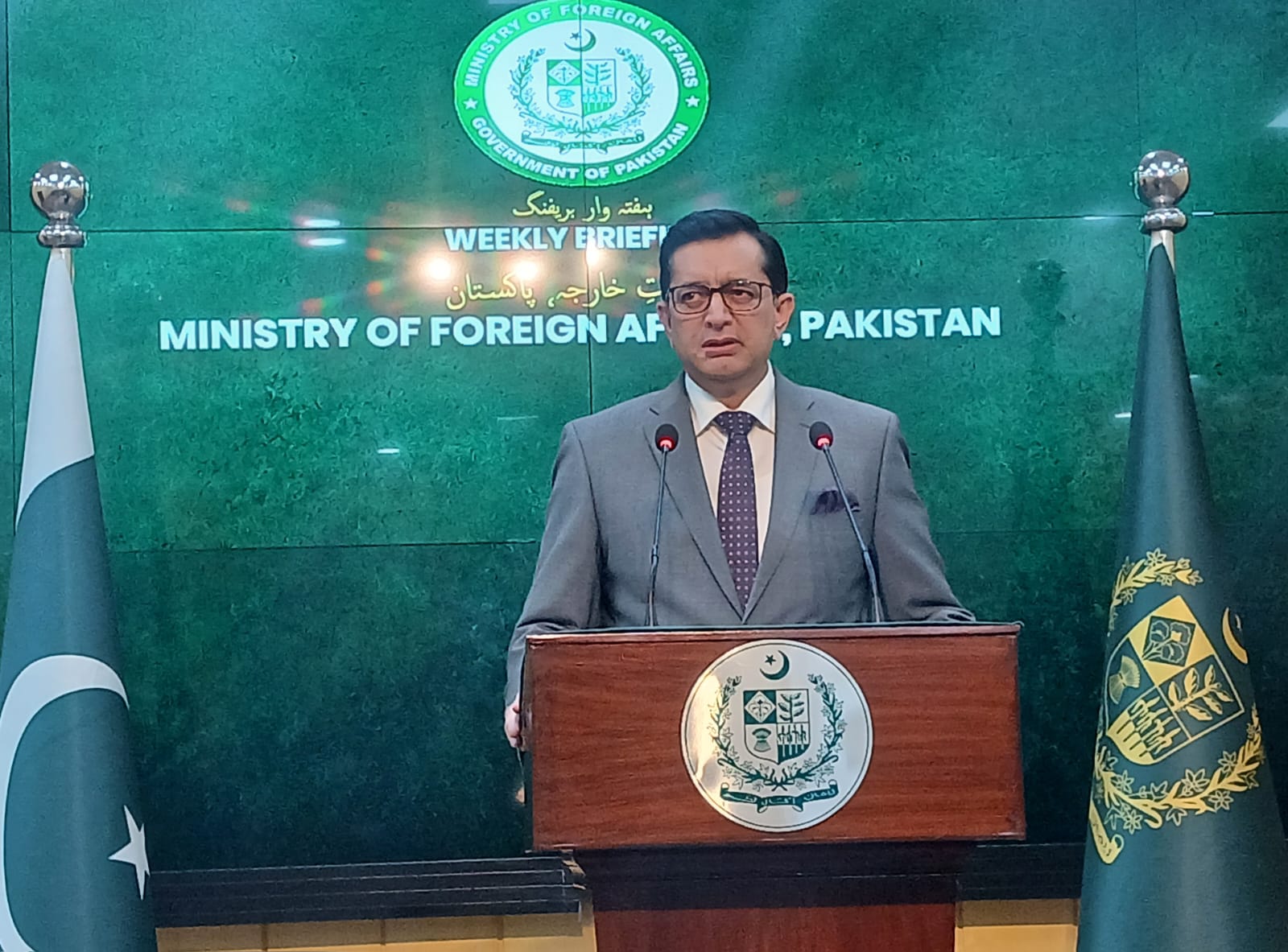
ISLAMABAD
Pakistan has renewed its call for dialogue, restraint and diplomatic engagement to address escalating regional tensions, reaffirming its commitment to peace and stability while intensifying diplomatic coordination with the United States, Iran and key regional partners.
At the Foreign Office’s weekly press briefing on 23 October, the spokesperson underscored Pakistan’s determination to pursue peaceful solutions to regional conflicts, stressing that dialogue and diplomacy remained essential to preventing further escalation and safeguarding regional and international security.
Reiterating Islamabad’s role in facilitating engagement between Washington and Tehran, the spokesperson said Pakistan remained in communication with both sides and had urged them to exercise restraint, resolve outstanding differences through negotiations and honour their respective commitments under the Islamabad Memorandum of Understanding (MoU).
Pakistan believes that implementing the provisions of the MoU could help ease tensions and create conditions for a peaceful resolution of the conflict, the spokesperson said, adding that Islamabad would continue to support diplomatic efforts in the broader interest of regional stability.
Addressing questions about reports of disruptions along the Pakistan-Iran border, the spokesperson reaffirmed Pakistan’s commitment to applicable international and domestic legal frameworks. He said he did not have direct knowledge of the latest operational situation at the crossings but noted that pilgrims, known as Zaireen, continued to travel between the two countries.
The spokesperson also emphasised that Pakistan attached considerable importance to its longstanding partnership with the United States, expressing Islamabad’s commitment to strengthening bilateral diplomatic, economic and security ties while continuing its efforts to promote peace through mediation.
Pakistan Rejects India’s Objections to OIC Kashmir Resolutions
Pakistan categorically rejected India’s criticism of the resolutions adopted at the 52nd session of the Organisation of Islamic Cooperation (OIC) Council of Foreign Ministers in Baghdad, describing the resolutions as a reaffirmation of the Muslim world’s longstanding position on the Jammu and Kashmir dispute.
The Foreign Office spokesperson said the resolutions reflected the collective position of OIC member states and reaffirmed the Kashmiri people’s inalienable right to self-determination in accordance with relevant United Nations Security Council resolutions.
The OIC, he noted, had rejected India’s unilateral measures aimed at altering the internationally recognised disputed status of Jammu and Kashmir and called upon the international community, including the UN Security Council, to take effective measures to implement the relevant resolutions.
Pakistan urged India to respect the fundamental rights of the Kashmiri people, honour its international obligations and create conditions for a peaceful settlement consistent with international law and the wishes of the people of Jammu and Kashmir.
The spokesperson stressed that the dispute remained an international concern requiring a just and lasting resolution.
Pakistan Voices Concern Over Threat to Historic Mosque in New Delhi
The Foreign Office also expressed grave concern over reports that the Indian government had issued an eviction notice against the historic Race Course Mosque in New Delhi.
The spokesperson said the mosque, described as a waqf property and heritage site, was facing the threat of demolition. He linked the development to wider concerns about reported actions against Muslim places of worship and waqf properties in India.
Referring to reported mosque demolitions in Saharanpur, Ujjain and other locations, he called on the international community to take notice and urge Indian authorities to protect religious sites and uphold the rights of minority communities.
Pakistan maintained that places of worship and religious heritage must be protected in accordance with applicable international obligations and principles of religious freedom.
Pakistan Clarifies Position on Makkah Joint Defence Agreement
Responding to questions about the Makkah Joint Defence Agreement between Pakistan, Saudi Arabia and Türkiye, the spokesperson said the arrangement reflected the three countries’ shared commitment to collective defence, deterrence and regional stability.
He confirmed that Pakistan endorsed the text made public through the Turkish Parliament, stating that the agreement comprised 16 articles and contained no hidden provisions.
According to the spokesperson, Pakistan and Saudi Arabia had completed their respective ratification processes, while Türkiye was undertaking the necessary procedures under its domestic legal framework.
He emphasised that the agreement was defensive in nature, consistent with Article 51 of the UN Charter and not directed against any particular country.
Addressing questions about the implications of external armed aggression against any of the participating countries, the spokesperson said the nature and extent of collective assistance would be determined by the three parties in accordance with the agreement and the circumstances of the situation.
Four Muslim-Majority Countries Sign Badr Defence Industry MoU
Pakistan, Qatar, Türkiye and Indonesia signed the Badr Multilateral Memorandum of Understanding in Doha on 21 October to strengthen cooperation in defence industries.
Defence Minister Khawaja Muhammad Asif attended the signing ceremony alongside senior defence representatives from the participating countries.
The Foreign Office spokesperson said the framework would facilitate cooperation in defence manufacturing, technology transfer, technical training, research and development, technological innovation and industrial capacity building.
Highlighting the complementary industrial capabilities of the participating countries, he expressed hope that the agreement would encourage the exchange of expertise, joint ventures and new avenues of collaboration.
The spokesperson clarified that the MoU established a framework for cooperation, with specific initiatives to be developed through subsequent protocols, understandings and agreements.
Pakistan and EU Deepen Counterterrorism Cooperation
Pakistan and the European Union held the 10th round of their Bilateral Counterterrorism Dialogue in Islamabad on 22 October, reviewing regional and international developments affecting the evolving terrorist threat landscape.
The Pakistani delegation was led by Director General (Counterterrorism) Dr Fareha Bugti, while the EU delegation was headed by Anna Strzaska, Special Envoy for Counterterrorism at the European External Action Service.
Both sides condemned terrorism in all its forms. The EU also condemned recent terrorist attacks in Pakistan, expressed solidarity with affected civilians and acknowledged Pakistan’s counterterrorism efforts.
The discussions focused on countering violent extremism, terrorist financing, radicalisation and the misuse of cyberspace by terrorist groups. The two sides also expressed concern about the security implications of developments in Afghanistan and underscored the importance of closer coordination at multilateral forums, particularly the United Nations.
Pakistan and the EU reaffirmed their commitment to sustained institutional cooperation and agreed to hold the next round of the dialogue in Brussels in 2027.
Pakistan Expands Diplomatic Engagement Across Europe
The spokesperson highlighted Pakistan’s continued efforts to strengthen political, economic and institutional ties with European partners.
Pakistan and Lithuania held the eighth round of Bilateral Political Consultations virtually on 19 October, discussing trade, investment, information technology, digital services, education and professional mobility.
Similarly, Pakistan and Latvia held the seventh round of Bilateral Political Consultations virtually on 21 October. The discussions focused on expanding trade and investment, strengthening digital cooperation, facilitating professional mobility and promoting educational exchanges.
Meanwhile, President Asif Ali Zardari was undertaking an official visit to Germany from 22 to 24 October, with engagements planned with his German counterpart, senior government officials and business representatives. The visit coincided with the 75th anniversary of diplomatic relations between Pakistan and Germany, providing an opportunity to explore further avenues of economic and commercial cooperation.
Pakistan Advocates Regional Integration at SCO and R4 Meetings
Deputy Prime Minister and Foreign Minister Senator Mohammad Ishaq Dar participated in the Shanghai Cooperation Organisation Council of Heads of Government meeting in Dushanbe, Tajikistan, on 20 October.
Addressing the meeting, he reaffirmed Pakistan’s commitment to the Shanghai Spirit and called for stronger regional connectivity, economic integration, trade, investment and financial cooperation.
He also highlighted the importance of collaboration in climate resilience, technological innovation, secure supply chains, energy connectivity, and educational and cultural exchanges.
In separate telephone conversations on 18 October, Dar discussed regional developments with Egyptian Foreign Minister Dr Badr Abdelatty and Iranian Foreign Minister Seyyed Abbas Araghchi.
During his conversation with Abdelatty, both sides condemned Houthi attacks against Saudi Arabia and reaffirmed their support for the Kingdom’s sovereignty, territorial integrity and security. They also discussed coordination under the Regional Four (R4) framework, comprising Pakistan, Saudi Arabia, Türkiye and Egypt.
In his conversation with Araghchi, Dar emphasised the importance of dialogue and diplomacy in addressing regional challenges, with both sides agreeing to remain in close contact.
On 23 October, Dar departed for Istanbul to participate in the R4 and R4+E3 foreign ministers’ meetings. The expanded format brings together Pakistan, Saudi Arabia, Türkiye and Egypt with the United Kingdom, France and Germany.
The discussions are intended to provide an opportunity to review regional developments, strengthen diplomatic coordination and explore collective approaches to maritime security, Yemen, Houthi-related developments and the Strait of Hormuz, with a view to promoting de-escalation and stability.
Pakistan Keeps Door Open to Dialogue with Afghanistan
On relations with Afghanistan, the spokesperson reaffirmed that Pakistan remained committed to a diplomatic solution but stressed that meaningful negotiations required credible assurances regarding the prevention of terrorist activities originating from Afghan territory.
He said Pakistan had engaged with the Afghan Taliban authorities through bilateral channels and regional platforms since 2021, including the Moscow Format and diplomatic efforts involving Qatar, Türkiye, Saudi Arabia and China.
According to the spokesperson, these initiatives had sought to establish a workable understanding between the two countries, but concerns over cross-border terrorism remained unresolved.
He said more than 1,300 Pakistanis had lost their lives in terrorist-related violence over the preceding year, underlining the serious security challenges confronting the country.
The spokesperson referred to UN monitoring reports and assessments by the Special Inspector General for Afghanistan Reconstruction (SIGAR), which he said indicated the presence of more than 20 terrorist organisations in Afghanistan.
Pakistan’s position, he emphasised, was that any renewed dialogue must be accompanied by a credible mechanism to prevent militant groups from using Afghan territory to threaten Pakistan and other countries in the region.
He added that Islamabad valued constructive engagement by Russia and other regional partners, while maintaining that any diplomatic initiative must address the underlying security concerns.
Pakistan Calls for International Protection of Indus Waters Treaty
Addressing the Indus Waters Treaty, the Foreign Office spokesperson said the issue extended beyond bilateral relations between Pakistan and India, raising wider questions about respect for international agreements and the principles governing shared water resources.
He called on the international community, the permanent members of the UN Security Council and relevant international institutions to uphold international law and ensure that treaty obligations were respected.
The spokesperson reiterated Pakistan’s position that its rightful share of water must not be diverted and referred to the National Security Committee’s previously stated warning that any diversion of Pakistan’s water would be treated as an act of war.
Pakistan, he said, would continue to defend its interests through the applicable legal and international frameworks.
Maldives State Visit Marks Milestone in Bilateral Relations
The spokesperson described Maldivian President Dr Mohamed Muizzu’s state visit to Pakistan from 20 to 22 October as an important milestone in relations between the two countries.
Accompanied by the First Lady and a high-level delegation, President Muizzu met President Asif Ali Zardari and held substantive discussions with Prime Minister Muhammad Shehbaz Sharif.
The two sides reviewed cooperation in trade, investment, health, education, tourism, agriculture, defence, maritime security, climate change and people-to-people exchanges. According to the Foreign Office, 20 agreements and memorandums of understanding were exchanged during the visit.
The visit was the first by a Maldivian president to Pakistan in 11 years and coincided with the 60th anniversary of diplomatic relations, reaffirming both countries’ interest in expanding their longstanding partnership.
On the future of the South Asian Association for Regional Cooperation (SAARC), the spokesperson said a functional regional organisation would benefit all member states through greater trade, connectivity and economic integration.
He attributed SAARC’s prolonged inactivity to India’s refusal to participate in the summit scheduled to be held in Islamabad in 2016, adding that renewed regional cooperation could serve the broader interests of South Asia.
Pakistan Reaffirms Commitment to the United Nations and Multilateralism
On 22 October, Dar addressed a ceremony in Islamabad marking United Nations Day and the 81st anniversary of the entry into force of the UN Charter.
He reaffirmed Pakistan’s commitment to multilateralism and highlighted the country’s longstanding contributions to UN peacekeeping, humanitarian assistance and international peace and security.
Emphasising dialogue, diplomacy and the peaceful settlement of disputes, he also acknowledged the continued partnership between Pakistan and the UN Country Team.
The Foreign Office spokesperson concluded that Pakistan would continue pursuing a constructive, balanced and proactive foreign policy grounded in sovereign equality, mutual respect, international law and peaceful cooperation.
He said Pakistan’s diplomatic engagement would remain focused on strengthening international partnerships, promoting regional stability, expanding economic cooperation and working with the international community to address shared challenges.
For Islamabad, the central message remains clear: sustained diplomatic engagement, respect for international obligations and a willingness to negotiate are essential to building a more peaceful and secure regional order.
