


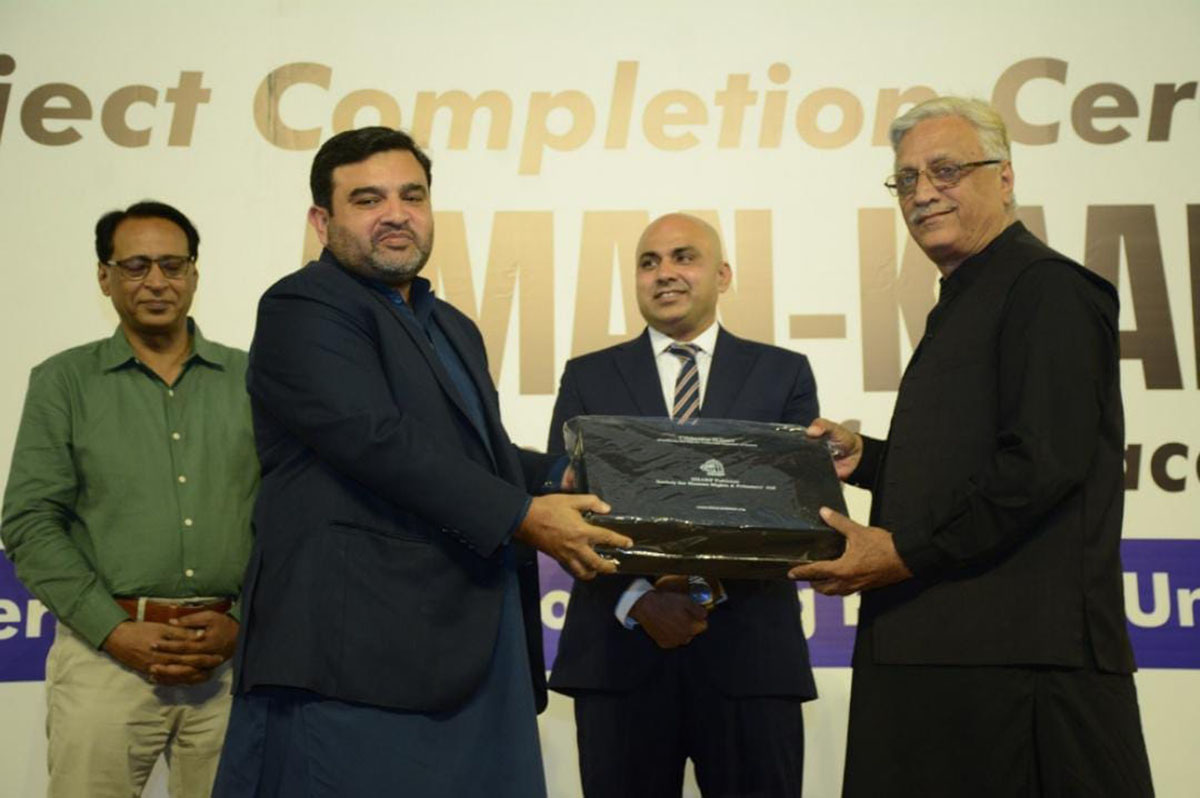
ISLAMABAD: — The Society for Human Rights & Prisoners’ Aid (SHARP), in collaboration with the National Counter Terrorism Authority (NACTA) and the United Nations Office on Drugs and Crime (UNODC), proudly concluded the AMAN-KAAR: Performers for Peace project at a vibrant closing ceremony held in Islamabad. Funded by the European Union, the initiative was implemented across eight districts of Pakistan to promote peace, tolerance, and social cohesion through creative youth engagement.
Responding to the growing need for social harmony and mutual respect, AMAN-KAAR adopted an innovative approach by empowering young people through theatre-based workshops, interactive performances, and inclusive community dialogues. Using theatrical games, real-life scenario enactments, and improvisational storytelling, the project encouraged empathy, celebrated diversity, and promoted collaborative problem-solving. The ceremony brought together representatives from SHARP, NACTA, UNODC, civil society, media, and youth leaders, reaffirming a shared commitment to inclusive community development.
The ceremony began with a welcome note by Mr. Mudassar Javed, SHARP’s CEO, who emphasized SHARP’s longstanding commitment to promoting human rights, peace, and social inclusion. He stated: “We are proud of our youth, who used the stage to become messengers of peace. At SHARP, we believe that engaging hearts is as important as engaging minds—and through this project, our youth have become ambassadors of hope.”
The peace project AMAN-KAAR’s fosters the peacebuilding legacy and has carried out 10 theatre workshops reaching 300 youth, focused on empathy, diversity, and community building across Pakistan; 16 live theatre performances across 8 districts, delivering messages of inclusion and mutual understanding and post-performance community dialogues engaged around 3,000 young people, fostering meaningful discussion and reflection.
The event featured impactful testimonials, a live theatre performance capturing the project’s core themes, a brief musical performance, and a dialogue segment where youth and SHARP team members offered reflections and suggestions for future initiatives.
Syed Arslan Zaidi, UNODC Advisor, shared: “UNODC is proud to support initiatives that use art and culture as instruments of social reform. These performances were appreciated in several educational institutes across Pakistan. Since the stories were collected from the same regions, their impact multiplied by the combination of music and humour.” He also thanked the European Union for its financial support to the UNODC project CPTP, mentioning that the EU firmly believes that peacebuilding must be inclusive, creative, and youth-centered.
Dr. Muhammad Bilal, a social cohesion and civic engagement expert and writer of the Beyond the Law book on PVE narratives, shared that initiatives like AMAN-KAAR should be incorporated into school and university frameworks.
Renowned artist and theatre expert Mr. Jamal Shah and Former Federal Minister of National Heritage and Culture of Pakistan was the chief guests on the occasion. “Theatre transcends social boundaries and speaks directly to the soul. These performances demonstrate how art can inspire, connect, and unite people,” he said in his remarks.
This activity marks a significant milestone of the project- CPTP, Countering and Preventing Terrorism in Pakistan. Funded by the EU, led by NACTA and executed by UNODC with its 30 partner civil society organizations like Sharp, the project aims at empowering community resilience against violent extremism and acts of violence via a three-pronged strategy. These 3 key components include: a. strengthen the capacity of criminal justice institutions; b. strengthen victim support through an effective legal system; c. foster community engagement via developing sustainable networks.
D.G NACTA, Dr. KHALID Chuhan also present on the occasion, who appreciated the insightful act. Referring to the National Policy on Prevention of Violent Extremism, he emphasized that using Culture to promote peace is an important pillar of this policy, and I affirm the support of the government of Pakistan for such projects.
In his closing remarks, SHARP Chairman, legal activist and famous column writer, Mr. Liaqat Banori, shared that AMAN-KAAR is not just the conclusion of a project—it marks the beginning of a broader movement. We thank our partners—NACTA, UNODC, and the European Union—for their trust and collaboration.
The ceremony concluded with a soulful musical performance celebrating Pakistan’s rich cultural diversity, followed by a group photo marking the success of a project that has inspired hearts and minds across the country.
EU firmly believes on peacebuilding. Arslan Zadi
210

